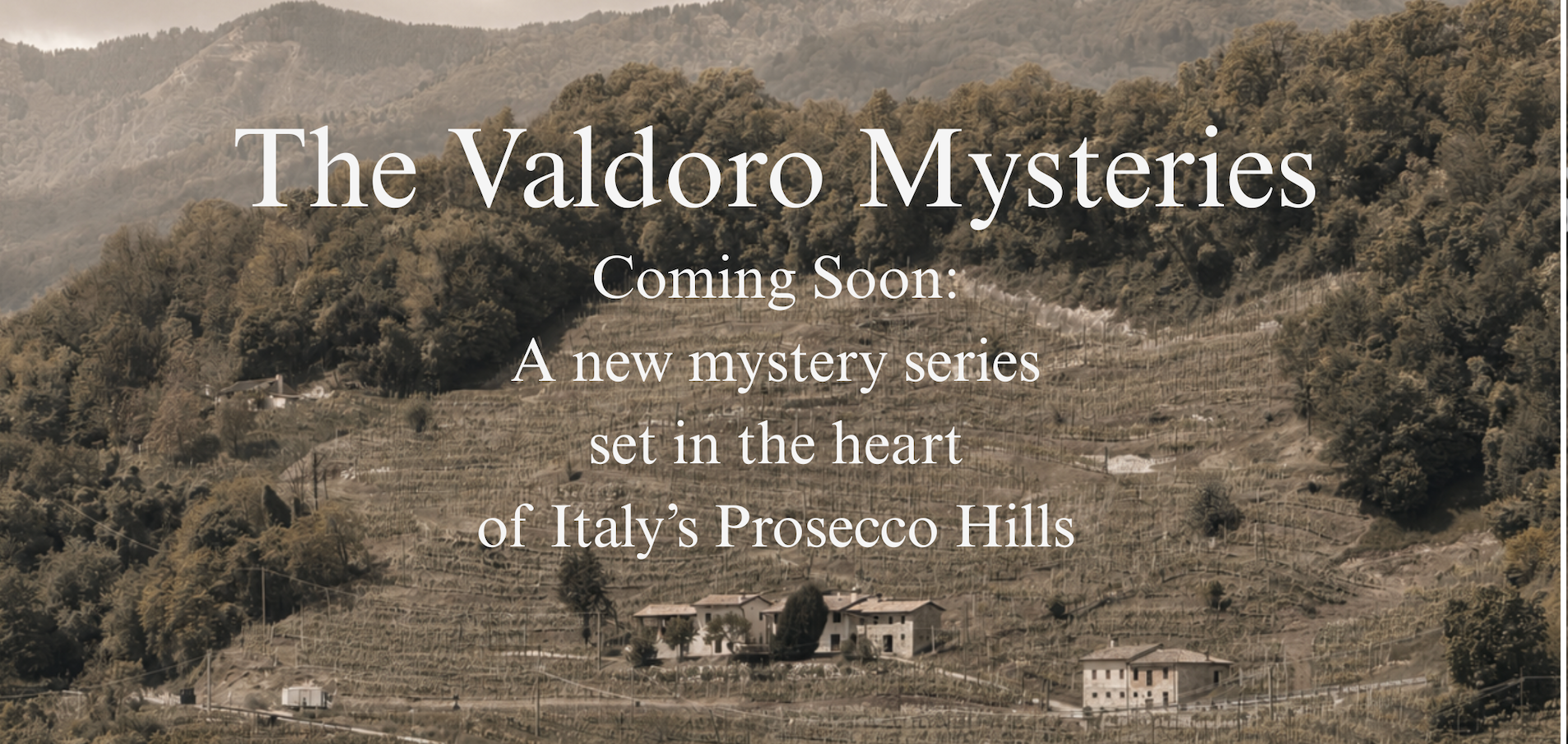
The Valdoro Mysteries are set in a fictional village in the Prosecco hills of the Veneto, in northeastern Italy, where the vineyards climb the slopes in disciplined rows, the bar opens before the village has fully woken, and families whose names are on the land have been measuring one another’s silences for generations.
Valdoro is a village of ordinary rituals and hidden histories: morning coffee taken standing at the bar, market bags heavy with seasonal food, church bells marking the day, elderly women on benches who have seen everything and say only what they choose, municipal offices where the right stamp can matter as much as the truth, and vineyards worked by families whose lives are tied to the hills in ways no postcard can explain. It is the kind of life that can look quiet from the outside, and can be easy to pass by without noticing.
Alice Marlowe, an American widow and former cultural attaché, inherits a house on the upper edge of the village from a great-aunt she barely knew. She comes to Valdoro to write, to grieve, and to discover whether a life can be rebuilt in a place where she knows no one and no one knows her. She stays because the village will not let her leave. It needs her, though it will be a long time before anyone admits this. And she stays because, almost against her own expectations, Valdoro gives her something she has not known before: the sense of living the right life in the right place.
Each book follows a self-contained mystery set in and around Valdoro. Alice’s warmth, trained eye, and outsider’s gift for noticing what local habit has made invisible allow her to see what others may miss, but she does not solve these mysteries alone. She offers assistance to Carlo Fiori, whose police work gives each case its official shape. Marta Ferro’s reporting often uncovers the thread no one else has followed. Sandro, Signora Coletto, Meg, Jonathan, Antonio, and the rest of the village all know pieces of what happened, though they rarely understand, at first, how much they know.
Beneath the individual mysteries runs a deeper thread: the story of Alice’s great-aunt Lucia, who did something brave and unacknowledged during the Second World War, and whose secret will take Alice five books to uncover.
The series is about old houses, vineyards, family reputation, food, wine, village loyalties, and the beautiful arrangements people make to hide what they cannot bear to face. It is about belonging: the slow crossing from being noticed, to being welcomed, to being trusted; the difference between entering a place and being claimed by it; and the possibility that starting over in midlife may lead not to escape, but to the first life that fully asks you to remain.
And within this intricate, ordinary, deeply rooted village life, there are moments when tragedy forces itself into the open. A death, a disappearance, a theft, or an old crime returns to disturb the daily rhythms of Valdoro, and everyone must live for a time with what the village has preferred not to see.
A Death in Valdoro
Book One in The Valdoro Mysteries
Alice Marlowe has come to Valdoro to write, to grieve, and to learn whether a life can be rebuilt in a place where she knows no one and no one knows her.
She has inherited a stone house on the upper edge of the village from a great-aunt she barely remembers, a woman named Lucia Moretti. At first, Valdoro offers Alice what she thinks she has come for: morning coffee at the bar, vineyard paths, market errands, the slow work of making a neglected house her own, and the quiet discipline of starting again.
Then Lorenzo Bressan is found dead near the boundary of an old parcel of vineyard land.
Lorenzo was respected, successful, and deeply rooted in Valdoro. His American wife, Meg, is foreign, unhappy, and not quite trusted. The village settles quickly on the easiest explanation: Meg must have killed him.
She says she did not.
The village thinks she did.
Alice Marlowe is not so sure.
The evidence against Meg begins to look persuasive, but Alice notices how quickly the story has arranged itself. Lorenzo is remembered as generous and patient. Meg is described as difficult, ungrateful, and unstable. The facts matter, but so does what Valdoro is willing to believe.
Alice has no official role in the investigation, but her background as a cultural attaché has trained her to read what people display, what they omit, and what they need others not to notice. As she offers assistance to Carlo Fiori, the young Carabinieri officer handling the case, and as Marta Ferro’s reporting begins to uncover what the village has left unexamined, the murder leads away from a simple domestic explanation and into the history of the vineyards themselves.
During the conversion to glera, the grape at the center of Prosecco production, land was rearranged, records were simplified, and one family’s prosperity may have been built on another family’s loss. What Valdoro remembers as progress may also have been theft.
Someone used the vineyard conversion to steal land. Lorenzo knew. And someone killed him before the old theft could be exposed.
To understand what happened, Alice must learn how Valdoro protects itself: through gossip, silence, hospitality, municipal records, old loyalties, family reputation, and beautiful things arranged to tell false stories. She will also begin to understand that her inherited house has its own place in the village’s memory, and that Lucia Moretti left behind more than a property.
A Death in Valdoro introduces Alice Marlowe, Carlo Fiori, Marta Ferro, Sandro behind the bar, Meg Bressan, Jonathan Cato, Antonio Baldini, Signora Coletto, and the village of Valdoro itself: a place of vineyards, food, habit, comedy, kindness, concealment, and old arrangements that do not stay buried forever.
The Villa Above the Vines
Book Two in The Valdoro Mysteries
When a long-abandoned villa above Valdoro is bought by a wealthy English couple, the village watches with suspicion, curiosity, and increasingly strong opinions about construction fences, cement mixers, and outsiders who think an old Italian house can be turned into a destination.
Alice Marlowe is drawn to Villa Leonardi for a different reason. The seventeenth-century house is being restored, and its walls are beginning to give up what they have hidden. Behind a sealed alcove, a fresco restorer uncovers a devotional painting with a family gathered in prayer. One figure has been added later: a young woman, painted into the family record and then violently erased. Her face has been scratched from the wall.
No one in Valdoro wants to say who she was.
The village remembers only fragments. A woman went away in the 1950s. Her name may have been Agnese Morosini. She was not from Valdoro. It was not discussed.
As Alice follows the traces of the vanished woman through parish records, property files, old building permits, and the silences of people who know more than they admit, the restoration architect working on the villa is found dead on the stone paving below the garden terrace.
The first explanation is convenient. An accident. An old wall. A restoration moving too quickly. A careless fall from a dangerous terrace.
But the wall is intact. The terrace is dry. The body is too far from the base of the wall. And the architect’s notebook is missing.
Alice begins to see that Villa Leonardi holds more than one secret. A defaced painting points toward a woman erased from the family’s history. A sealed lower level points toward something else: a hidden space, old valuables, wartime theft, and a silence that has profited from the dead for decades.
To understand what happened at the villa, Alice must learn how Valdoro preserves what it cannot bear to know: through omitted records, polite evasions, old family debts, and walls that have been opened and closed again by the same careful hand.
The Villa Above the Vines returns to Valdoro in late spring, when the vines are in leaf, the bar tables move into the piazza, the market is full of white asparagus and strawberries, and the village is once again forced to decide how much of the truth it is willing to see.
A Death at the Festa
Book Three in The Valdoro Mysteries
The village of Valdoro is preparing for the Festa di San Martino, a late-autumn celebration of new wine, chestnuts, procession, music, old rivalries, and the small negotiations required to keep a village tradition alive.
For Alice Marlowe, the festa should be one more sign that Valdoro has begun to claim her. The bar tables are argued over with the usual seriousness. The committee meets in the sala civica beneath photographs of former mayors. The chestnut grove above the village is turning toward winter. A young rider, Caterina Valenti, has arrived with her horse, her ambitious father, and the trainer whose charm has already begun to unsettle more than one household.
By the end of the festa, the trainer is dead.
His body is found in the passage beside the church after the village has gone home from the rain, the vin brulé, the procession, and the communal meal. Valdoro quickly gathers the pieces it wants to see: a public confrontation, a pair of missing fabric shears, a humiliated mayor, a woman whose private life has become village business, and a dead man almost everyone disliked once they began telling the truth about him.
The explanation seems obvious. Too obvious.
Alice has watched the festa closely. She saw the red cape, the scissors, the gesture at the edge of the meal, the hand on the arm, the moment when one man stopped himself from doing more. She knows that public shame can become motive. She also knows that villages often choose the story that protects them from seeing what they missed.
As Alice follows the case through committee rooms, parish records, riding circles, family loyalties, and the wintering chestnut grove, another pattern begins to appear. The dead trainer had a gift for finding vulnerable families, telling fathers what they wanted to hear, and turning daughters’ ambitions into instruments of dependence. What looked like arrogance may have been injury. What looked like disdain may have been despair. And what Valdoro dismissed as a failed performance may have been the visible edge of something far more damaging.
To understand what happened at the festa, Alice must read not only the evidence, but the village’s first response to it: who laughed, who looked away, who rushed to blame the convenient man, and who knew too late that the story everyone believed had missed the person most in pain.
A Death at the Festa returns to Valdoro in late autumn, when the vines are bare, the chestnuts fall, the ugly streetlight still offends the piazza, and the village must reckon with the difference between witnessing an event and understanding what has happened.
And the Value of None
Book Four in The Valdoro Mysteries
An elderly woman in Valdoro begins to suspect that something is wrong with the jewelry she has guarded for decades. One by one, heirloom gemstones appear to have been replaced with poorer stones, paste, or glass. The pieces look almost right to anyone who does not know them intimately, but she knows what was given, what was inherited, and what each setting once held.
Then another widow is found dead.
The dead woman was not only a neighbor. She was a rival, bound to the first widow by a history neither of them had ever fully told. Their shared past reaches back into family reputation, inheritance, jealousy, and the quiet calculations women sometimes make when the village gives them too few choices and remembers every one of them.
The evidence begins to point toward the woman whose jewelry was altered. She had motive, opportunity, and a lifetime of reasons to resent the dead. But Alice Marlowe is not convinced that stolen stones and old hatred tell the whole story.
To understand what happened, Alice must look closely at the difference between value and appearance: what is real, what is imitation, what has been substituted, and what Valdoro has learned to admire without asking how it came into anyone’s hands.
A Death at the Wine Prize
Book Five in The Valdoro Mysteries
The DOCG wine prizes should be one of the proudest nights of the year: polished glasses, careful speeches, rival producers watching one another with practiced courtesy, and Valdoro’s finest Prosecco poured for judges, families, officials, and guests.
Then a local producer dies during the awards.
The question is simple and impossible: who poisoned the wine?
Every possible suspect was there. Competitors, relatives, judges, employees, old rivals, and people with debts no one mentions in public all stood in the same room, watching the same ceremony unfold. The prize was supposed to honor excellence, tradition, and the future of the hills. Instead, it exposes ambition, resentment, inheritance disputes, falsified histories, and the cost of turning land into prestige.
As Carlo Fiori investigates the official evidence and Marta Ferro follows the story through Valdoro’s wine world, Alice Marlowe notices what ceremony is designed to conceal: the order of the pours, the placement of the glasses, the speeches no one wanted interrupted, and the people who looked less surprised than they should have been.
A Death at the Wine Prize brings the five-book arc of The Valdoro Mysteries into the polished, competitive world of Prosecco itself, where reputation can be worth more than truth, and one poisoned glass can reveal what the whole village has been refusing to taste.
The series brings Valdoro to life
Each Valdoro mystery returns readers to the same village world: morning coffee at Bar Centrale, walks through the vineyards, market mornings, seasonal meals, old houses, church records, municipal files, village comedy, and conversations in which everyone seems to know slightly more than they are willing to say.
Across the series, Alice’s inherited house slowly gives up its history. The villagers know more about her family than she does. Some welcome her. Some watch her. Some have reasons to keep the past undisturbed.
Each book solves a new mystery, but the pleasure of Valdoro is also in returning: to Sandro behind the bar, claiming to know nothing while knowing everything; to Carlo Fiori, the young police officer learning that Alice often sees what official procedure cannot easily hold; to Antonio Baldini, whose knowledge of the vineyards comes with his own guarded silences; to Meg Bressan, the American widow from the first book, rebuilding her life with more courage than the village first allowed her; to Jonathan Cato, the art restorer whose careful hands uncover more than old paint; to Marta Ferro, the reporter who hears a story before anyone else admits there is one; and to Signora Coletto, who remembers nearly everything and releases the truth only in fragments, delays, corrections, and apparently irrelevant remarks.
Valdoro becomes more familiar with each book, but familiarity does not make it simple. The piazza, the bar, the church, the vineyards, and the old houses all keep their own memories, and Alice learns, one secret at a time, what it means to belong to a place that has not yet decided whether to trust her.